L23: Registers#
Let’s practice Boolean algebra!
Objective
Practice usage of theorems 5-17 of Boolean algebra.
Before the Lecture#
Required Textbook Reading:
- 5.8 (Registers)
Registers#
A flip-flop stores one bit of information. A group of n flip-flops can store n bits, such as an n-bit number; this group is called a register. In a register, all flip-flops are typically clocked simultaneously, allowing the entire register to be updated in parallel. Registers can be used for temporary storage of data, intermediate results, or as part of a larger digital system.
Shift Registers#
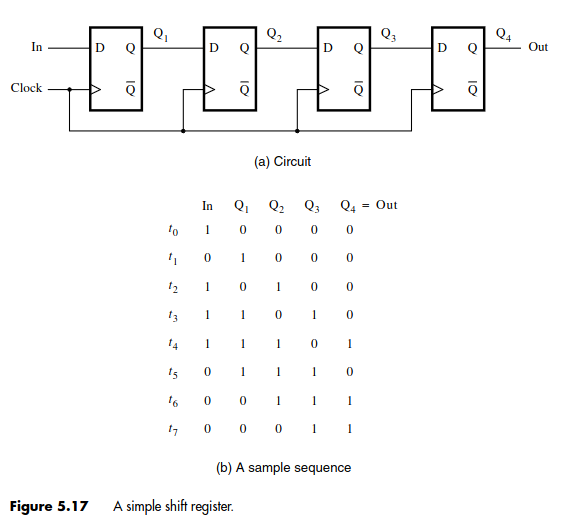
We know that shifting Boolean numbers left or right is equivalent to multiplying or dividing by 2. A shift register is a type of register that allows data to be shifted in or out one bit at a time, either to the left or right. This is useful for serial-to-parallel and parallel-to-serial data conversion, as well as for implementing delay lines and other sequential logic functions.
Parallel Access Shift Registers#
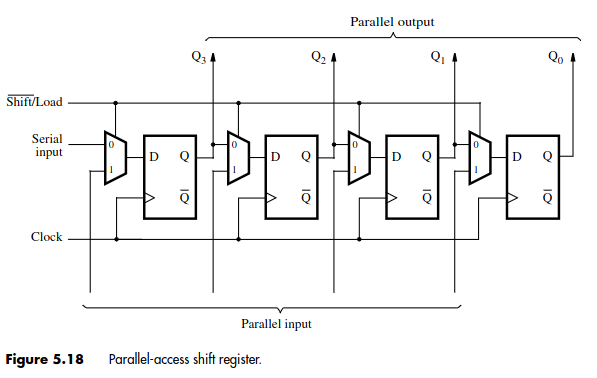
To allow for parallel access to the data stored in a shift register, we can use additional logic to read or write multiple bits simultaneously. This can be achieved by using multiplexers or additional flip-flops to capture the state of the shift register at a given time.