L22: Flip Flops#
Let’s practice Boolean algebra!
Objective
Practice usage of theorems 5-17 of Boolean algebra.
Before the Lecture#
Required Textbook Reading:
- 5.4–5.7 (Flip Flops)
Edge-Triggered D Flip Flops#
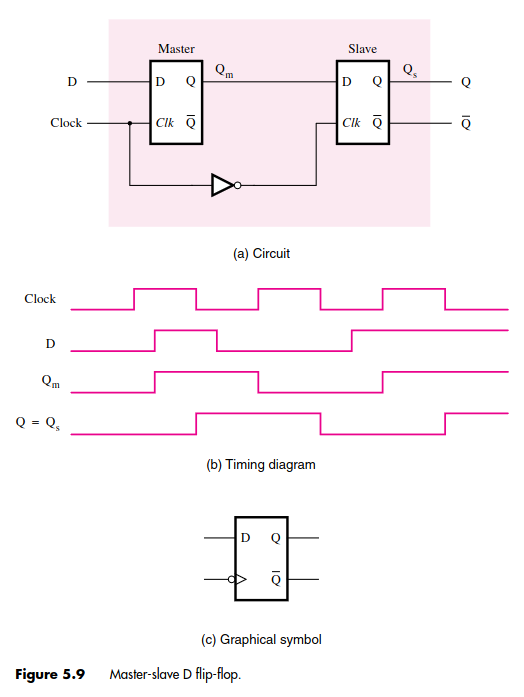
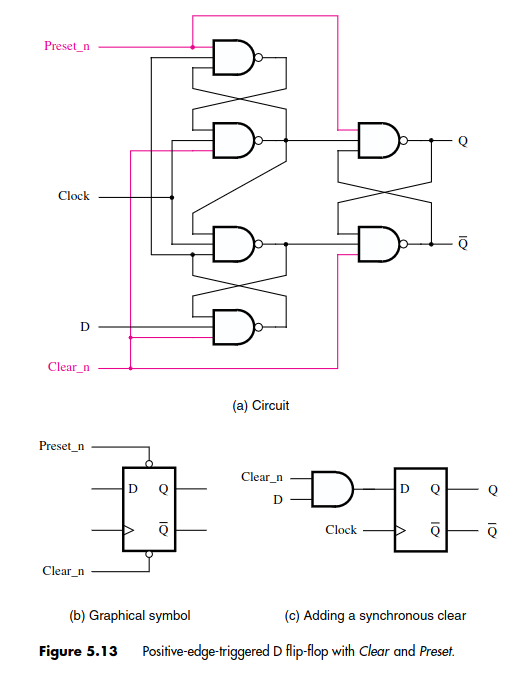
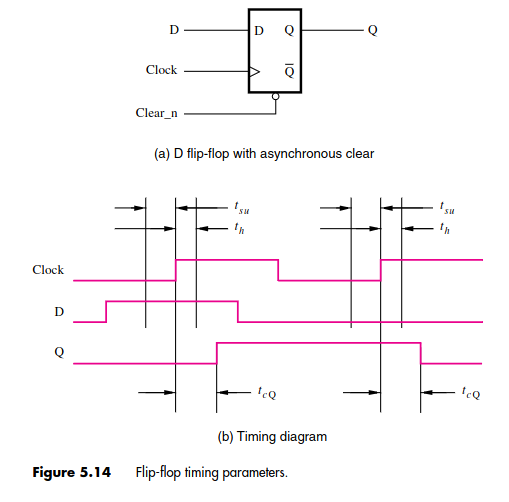
Edge-triggered flip-flops change their output only at specific moments when the clock signal transitions from low to high (rising edge) or from high to low (falling edge). This makes flip-flops more suitable for synchronous circuits where precise timing is crucial.
Clear and Preset Inputs#
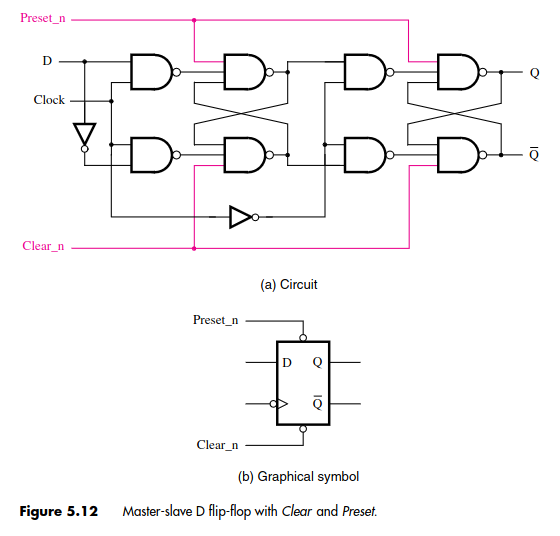
A flip-flop may have additional inputs called clear and preset. The clear input forces the output to 0, while the preset input forces the output to 1, regardless of the clock or data inputs. These inputs are typically asynchronous, meaning they can change the state of the flip-flop immediately, without waiting for a clock edge.
T Flip Flops#
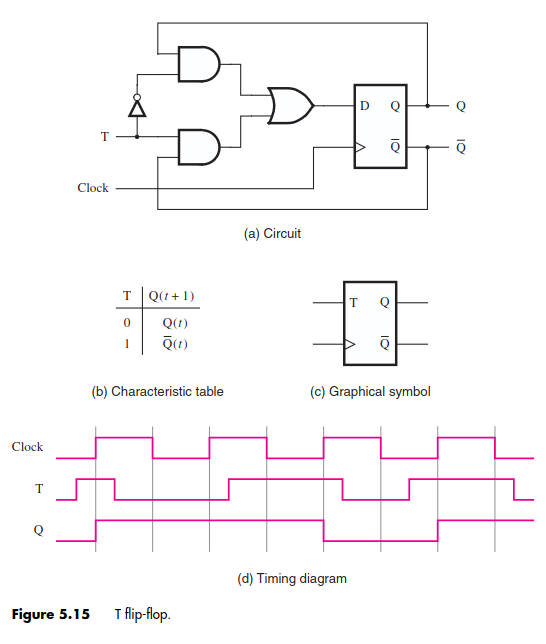
A T flip-flop (Toggle flip-flop) is a type of flip-flop that toggles its output state on each clock pulse when the T input is high. When T is low, the flip-flop maintains its current state. This makes it useful for creating counters and other applications where a simple toggle operation is needed.
JK Flip Flops#
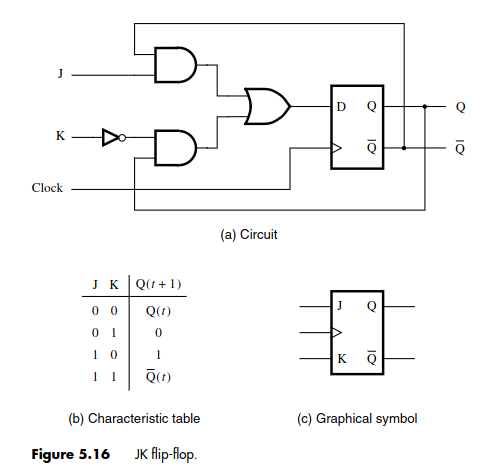
A JK flip-flop is a versatile type of flip-flop that can operate in different modes based on the inputs J and K. When both J and K are high, the output toggles on each clock pulse. When J is high and K is low, the output sets to 1. When J is low and K is high, the output resets to 0. When both J and K are low, the output remains unchanged. This flexibility makes JK flip-flops suitable for a wide range of applications.