L24: Counters#
Let’s practice Boolean algebra!
Objective
Practice usage of theorems 5-17 of Boolean algebra.
Before the Lecture#
Required Textbook Reading:
- 5.9–5.10 (Counters)
- 5.11 (Other Types of Counters) Self-Study
Counters#
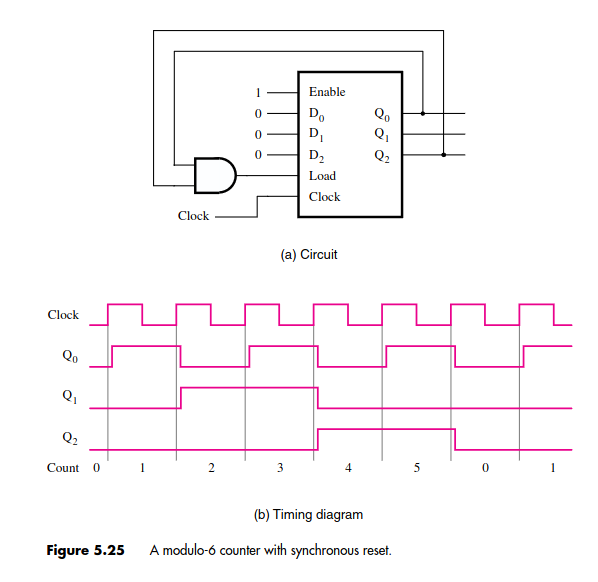
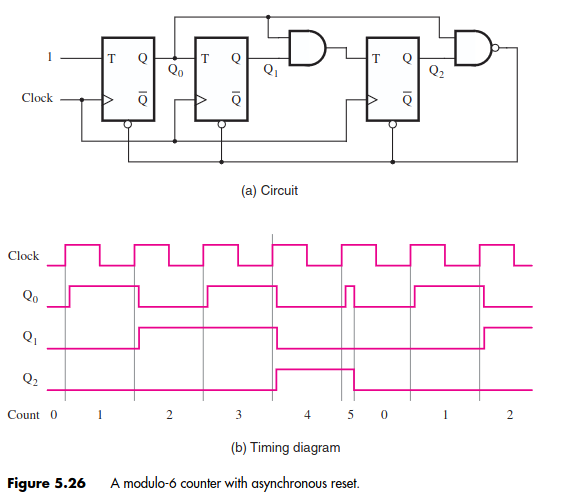
Counters could be created using adder/subtractor circuits, but this would be inefficient. Instead, we can use flip-flops to create counters. A counter is a sequential circuit that goes through a predetermined sequence of states upon the application of input pulses. Counters can be classified as either synchronous or asynchronous.
Asynchronous Counters#
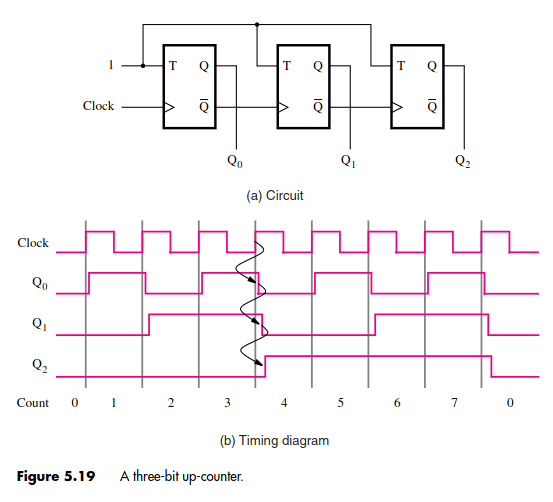
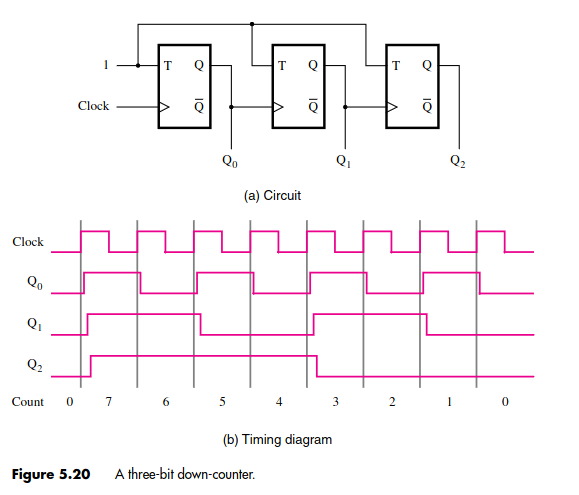
Asynchronous counters, also known as ripple counters, are counters in which the flip-flops are not clocked simultaneously. Instead, the output of one flip-flop serves as the clock input for the next flip-flop in the sequence. This causes a ripple effect, where the change in state propagates through the flip-flops one at a time.
Counters with T Flip-Flops#
Synchronous Counters#
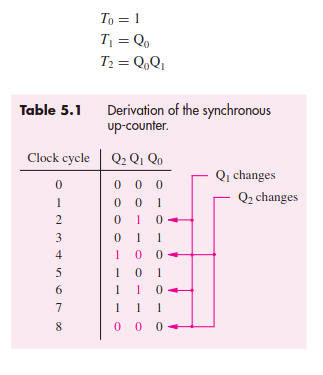
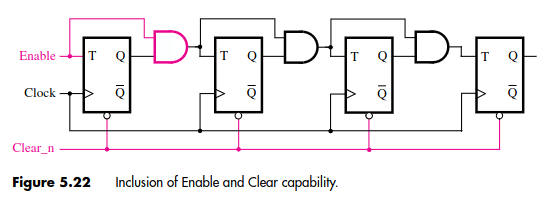
Synchronous counters are counters in which all flip-flops are clocked simultaneously by a common clock signal. This allows for faster operation and eliminates the ripple effect seen in asynchronous counters. Synchronous counters can be designed to count in both up and down directions, and they can also be configured to count in specific sequences.
D Flip-Flop Counters#
Reset Synchronization#
When designing counters, it is important to ensure that the reset signal is synchronized with the clock signal to avoid metastability and ensure reliable operation. This can be achieved by using additional flip-flops to synchronize the reset signal with the clock.